Why Grok Matters More Than Before
The story around Grok by xAI has changed quickly. What began as a headline-grabbing chatbot is now being presented as a broader consumer and creator product that spans chat, voice, image generation, and video creation. That shift matters because it changes how people should think about Grok. It is no longer only a tool for asking questions or getting real-time responses. It is increasingly becoming a platform story.
That is where the latest news becomes important. Recent xAI announcements have put extra attention on the company’s speed, funding, and product direction, while Grok Imagine has given the Grok ecosystem a much stronger media-generation angle. For readers tracking where generative AI is heading next, the real question is no longer whether Grok AI can compete in chat. It is whether the Grok brand can grow into a serious multi-format creative stack.
The Latest xAI News in Plain English
Several updates pushed xAI back into the center of the AI conversation. At the company level, xAI has highlighted major momentum in 2026, including fresh funding and its new ownership context under SpaceX. Those developments do not automatically make the products better, but they do help explain why xAI is moving so aggressively across consumer AI, developer APIs, and media generation.
At the product level, the more interesting story is how xAI is framing Grok itself. The company is now presenting Grok as a chatbot with voice, advanced reasoning, coding help, real-time search, image generation, and video generation. That broader positioning makes Grok AI feel less like a single app and more like a family of experiences.
For everyday users, that means the Grok conversation is no longer just “How good is it at answers?” It is also “How useful is it for content creation, experimentation, and production workflows?” That is the context in which Grok Imagine has become important.
What Grok Imagine AI Actually Adds
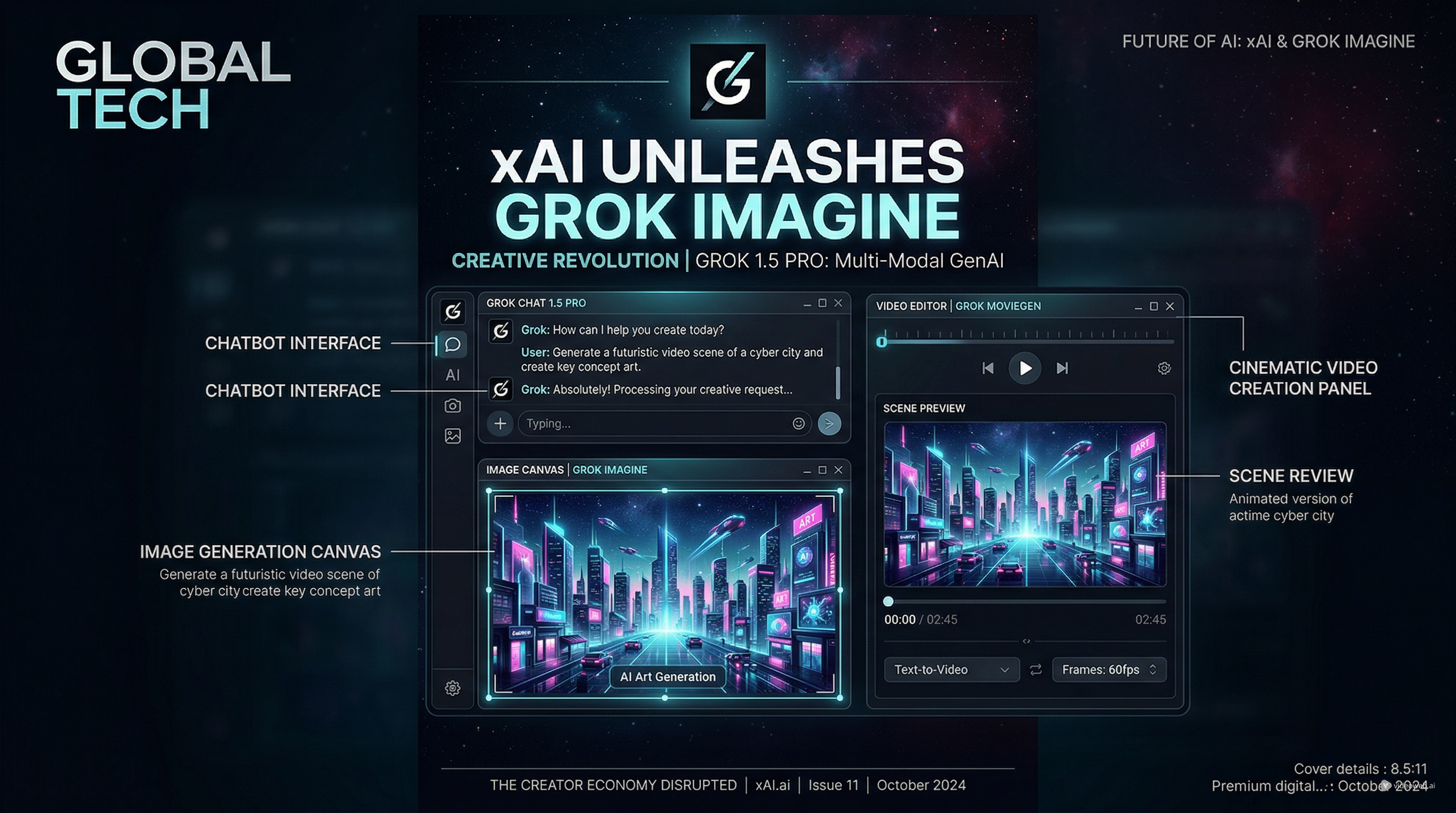
Grok Imagine AI is the clearest sign yet that xAI wants to compete beyond text. Instead of treating media generation as a side feature, xAI is presenting Grok Imagine as a serious creative system for images, video, and even audio-linked workflows.
What makes this launch notable is not just that it exists, but how it is being described. xAI is emphasizing quality, cost, and latency, while also pushing the idea of a more complete creative pipeline. In practical terms, that means Grok Imagine AI is being positioned as something creators can use for more than novelty images. The bigger goal appears to be end-to-end generation, editing, and iteration.
That is why Grok Imagine feels different from a simple “now we do images too” announcement. It signals that xAI wants Grok to be part of the same broader conversation as modern creator tools, not just chatbots.
Why Grok Imagine Video Is the Real Test
If there is one part of the rollout to watch most closely, it is Grok Imagine video. Image generation is already crowded, and every major AI platform now wants to be taken seriously in visuals. Video is where ambition becomes easier to measure.
Grok Imagine video matters because it speaks directly to how creators actually work now. Many users do not want separate tools for script ideation, image creation, animation, and editing. They want fewer steps, cleaner interfaces, and faster iteration. A strong Grok Imagine video workflow could make Grok much more appealing to creators, marketers, and teams who need fast output without a traditional production process.
That is also why it makes sense to test Grok-adjacent workflows on broader tool hubs. If you want a practical entry point right now, Grok 4 on Chat4o is the easiest place to start for readers who want to try the current Grok experience in a live environment. It gives you a direct way to sample the chat and reasoning side before branching into media tools.
How Chat4o Fits the Grok Workflow
For many users, the appeal of Chat4o is not that it replaces xAI’s official ecosystem. It is that it gives you a practical hub for trying multiple AI models and creative tools in one place. That is useful when you want to compare outputs instead of committing to a single brand narrative.
If you start with Grok 4, you can then move into tools that support the same broader creator mindset. The Text to Video Generator is useful when you want to turn a simple idea into a first visual draft. The Image to Video Generator makes more sense when you already have a reference image and want motion, scene energy, or a short cinematic result.
That is where the current Grok AI conversation becomes more practical. Even if a user comes in because of xAI headlines, they often stay because they want to build something. A model page alone is rarely enough. People want a workflow.
Other Chat4o Models Worth Comparing
Grok does not exist in a vacuum, and that is part of what makes trial hubs useful. After testing Grok 4, it is worth comparing how different tools behave depending on the job.
For still images, the GPT-4o Image Generator is a logical companion if you want to compare general-purpose image creation against the newer energy around Grok Imagine AI. For video generation, Kling 3.0 and Veo 3.1 are both useful reference points when you want to judge motion quality, prompt response, and overall output style.
This matters because the future of Grok Imagine video will not be judged in isolation. It will be judged against what creators can already access elsewhere. In that sense, trialing Grok-related tools alongside established image and video models is the most practical way to understand where Grok really stands.
So, Is Grok’s Momentum Real?
The short answer is yes, but with an important caveat. The momentum is real in the sense that xAI is clearly expanding Grok’s role and telling a much bigger story than before. Funding, company news, API growth, and media-generation ambitions all point in the same direction: xAI wants Grok to be seen as a major AI platform, not just a provocative chatbot.
The caveat is that platform ambition and everyday creator value are not always the same thing. What matters next is consistency. Can Grok Imagine AI become something people return to for real work? Can Grok Imagine video produce outputs strong enough to hold attention in a crowded market? And can Grok AI keep improving as both a reasoning assistant and a creative entry point?
Right now, the most practical answer is to watch the official updates, then test the experience yourself. Start with Grok 4 on Chat4o, compare it with Kling 3.0 or Veo 3.1, and use tools like the Text to Video Generator and Image to Video Generator when you want a more hands-on creator workflow. That gives you a much clearer picture than headlines alone.
Final Thoughts
xAI is no longer just selling a chatbot story. With Grok AI, Grok Imagine AI, and the growing focus on Grok Imagine video, the company is making a clear play for relevance across chat, media generation, and creator workflows.
Whether that turns into long-term leadership is still an open question. But as of now, Grok is more important than it was a year ago, more ambitious than many people expected, and much more worth testing directly. If you want to follow where this category is going, Grok deserves attention. If you want to try it in practice rather than just read the news, Grok 4 is the most straightforward place to begin.
More Tools and Models to Explore
Related Article
- Grok Imagine AI Video Generation on Chat4O: A Step-by-Step Tutorial + Ready-to-Use Prompts
- Discover Grok 4 AI – Elon Musk’s Next‑Gen AI Model, Now on Chat4o
- Grok 4 vs Chat GPT 5 (2026): Which AI Fits You Best?
- ChatGPT vs Grok vs Claude vs Gemini in 2026: Which AI Actually Leads Where?
People Also Read
- How to Use the AI Music Video Generator: A Detailed Guide from Song to Video
- HeyDream AI Image Generator Guide: Best Models for Text-to-Image and Image-to-Image
- Veo 3.1 vs Luma Ray2 on DreamMachine AI: Which AI Video Model Fits Your Workflow?
- ChatGPT vs Grok vs Claude vs Gemini in 2026: Which AI Actually Leads Where?
- SeaImagine AI Text-to-Video Guide: How to Choose Models and Create Better Clips