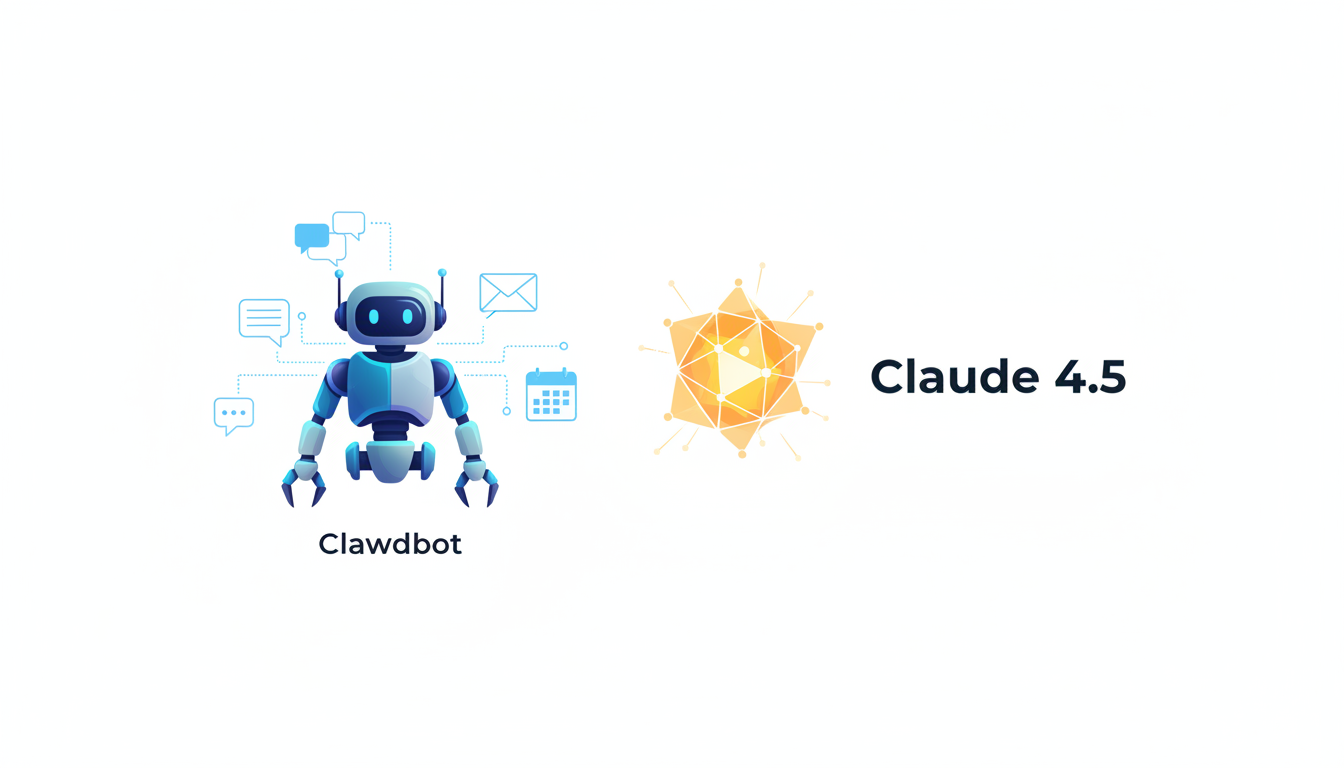
Most chatbots are great at answering questions. But when you’re juggling real life—emails, calendar changes, docs to summarize, tasks to track—what you really want is an assistant that can take action.
That’s where Clawdbot comes in: a free, open-source project designed around the idea that your assistant should live where you already communicate (like chat apps), and should be able to connect to tools.
And when you need a powerful “brain” for that assistant—especially for reasoning-heavy tasks, coding help, and long, multi-step requests—Claude AI is a natural fit.
In this guide, you’ll learn what Clawdbot is, how Claude 4.5 fits organically into an assistant stack, and why it can be smart to start with Claude 4.5 on Chat4o before deciding to self-host anything.
What Is Clawdbot (and Why It’s Different From “Just Chat”)
Let’s start with the core idea: Clawdbot isn’t trying to be another chatbot UI. It’s closer to an agent framework—a middle layer that helps you connect conversations to real tool use.
Here’s the simplest way to think about it:
- Chat app: where you talk to the assistant (your familiar interface)
- Clawdbot: the “router” that understands your messages and triggers tools
- AI model: the reasoning engine that decides what to do and how to respond
- Tools: things like email, calendar, docs, notes, or custom APIs
Because Clawdbot is open source, it’s especially appealing if you like:
- Owning your workflow instead of relying on one platform
- Connecting your assistant to your systems
- Experimenting with different model providers over time
If you’ve ever thought, “I wish my chatbot could actually do this for me,” you’re in Clawdbot territory.
Where Claude 4.5 Fits: The “Brain” for High-Quality Agentic Work
Clawdbot is the assistant framework. Claude 4.5 is the “thinking” part.
When people talk about building assistants, they usually discover a hard truth fast:
Tool integrations matter—but the model’s reasoning quality is what determines whether the assistant feels magical or frustrating.
That’s why it’s useful to mention Claude 4.5 organically here. The model family is often used for high-quality reasoning and coding tasks, which maps well to agent workflows.
What do we mean by “Claude 4.5 agentic workflows”?
An “agentic workflow” is just a fancy way of describing a request that requires multiple steps, often with tool use in the middle.
Here are examples that feel realistic and useful:
- Email triage: read a thread → summarize → draft a reply → ask for your approval
- Calendar assistant: scan availability → propose times → schedule after confirmation
- Doc-to-action: summarize a document → extract action items → turn them into tasks
- Coding helper: inspect error logs → suggest a fix → generate a patch snippet
Those are the kinds of tasks where strong reasoning, precise language, and structured output matter a lot—so a model like Claude 4.5 agentic workflows becomes more than a keyword. It becomes the difference between “toy demo” and “I use this daily.”
Two Ways to Use Claude With Clawdbot: Self-Hosted vs Hosted
If you’re reading this, you probably fall into one of two camps:
- You want to build and customize (self-host, integrate, automate).
- You want to use it now (no setup, no server, no fiddling).
Both are valid. The smart move is picking the order.
Path A: Self-host Clawdbot and connect Claude
If you self-host Clawdbot, you’re essentially building your own assistant environment. The exact setup differs by deployment style, but the moving parts tend to look like this:
- Choose an LLM provider (Claude is one option)
- Configure credentials and model selection
- Connect your channels (where you’ll chat)
- Grant tool permissions (email/calendar/docs/etc.)
- Define guardrails (what it can do automatically vs what needs approval)
This path is best when you:
- Want maximum control
- Need custom integrations
- Prefer self-hosting for privacy or reliability
Path B: Start hosted with Claude 4.5 on Chat4o
If your real goal is “I want Claude 4.5 working for me,” you don’t need to start with infrastructure.
A hosted experience like Claude AI on Chat4o can be the fastest first step because you can:
- Test your prompts and workflows immediately
- Confirm Claude 4.5 fits your style
- Learn what you actually want to automate later
Then, if you outgrow the hosted UI and need tool integrations or deeper ownership, you bring those validated workflows into Clawdbot.
A Practical Claude Models Overview (So You Don’t Overthink It)
Most people get stuck here: “Which Claude model should I choose?”
If you want a quick mental model, use this:
- Default choice (balanced): start with the latest strong general model (often Sonnet-tier)
- Maximum performance: go up a tier when quality matters more than speed/cost
- Fast + lightweight: go down a tier when you need quick answers at scale
If your article readers want a single place to orient themselves, you can point them to a Claude models overview and then keep your guidance practical.
Rule of thumb:
- For everyday planning + writing + structured outputs → start with the balanced option.
- For complex reasoning or multi-step tasks → move up.
What “Claude API Models” Means (For Builders)
If you’re building with Clawdbot, you’ll eventually run into this phrase: “API models.”
All it means is: instead of using Claude through a chat UI, you’re calling the model programmatically so your assistant can:
- Send structured requests
- Receive structured outputs
- Trigger tool calls
- Run multi-step flows reliably
That’s why builders care about Claude API models.
What to check before you wire it into your assistant
Here’s a simple checklist that keeps you out of trouble:
- Context needs: will your tasks involve long docs or long conversations?
- Reliability: does it behave consistently with tool-style prompts?
- Latency vs quality: is “fast enough” more important than “best possible”?
- Guardrails: do you require approvals for sensitive actions?
Even if you don’t build today, these are useful questions—because they shape what kind of assistant you actually want.
Recommendation: Try Claude 4.5 on Chat4o First (Then Decide on Clawdbot)
Here’s the practical path that fits most people:
- Start with Claude AI on Chat4o.
- Use it for a week on real tasks (summaries, drafts, reasoning, coding, planning).
- Notice what you keep repeating—and what you wish it could “do” automatically.
- Then evaluate Clawdbot for the workflows that truly need integrations.
This sequence saves time because you’re not guessing. You’re validating.
A simple example of the progression
- Week 1: You use Chat4o to ask Claude 4.5 to summarize meetings and draft replies.
- Week 2: You realize the repeated steps are always the same.
- Week 3: You self-host Clawdbot so those steps can connect to email/calendar APIs—with approval prompts before sending anything.
That’s when Clawdbot becomes the “do-things” layer and Claude 4.5 becomes the consistent reasoning engine behind it.
FAQ
Is clawdbot really free and open source?
Yes—clawdbot is positioned as an open-source project you can self-host and customize.
What are “Claude 4.5 agentic workflows,” in plain English?
They’re multi-step tasks—often with tool use—like “summarize this doc, extract action items, and draft a follow-up email.” See the Claude 4.5 agentic workflows examples above.
Do I need Claude API models to use Claude?
Not if you’re just chatting. API access matters when you’re building assistants that call the model programmatically—like wiring Claude into an agent framework. That’s the core use case behind Claude API models.
When should I choose Chat4o vs self-hosting Clawdbot?
- Choose Chat4o if you want speed, convenience, and a ready UI.
- Choose Clawdbot when you need ownership, integrations, and automation.
Bottom Line
If your end goal is an assistant that acts, clawdbot gives you a flexible, open-source foundation.
If your end goal is high-quality reasoning and strong multi-step execution, Claude AI is a strong fit.
And if you want the simplest, viewer-first way to begin: start by using Claude 4.5 on Chat4o, prove the workflows you’ll actually use, and only then decide whether it’s time to bring those workflows into a self-hosted assistant stack.