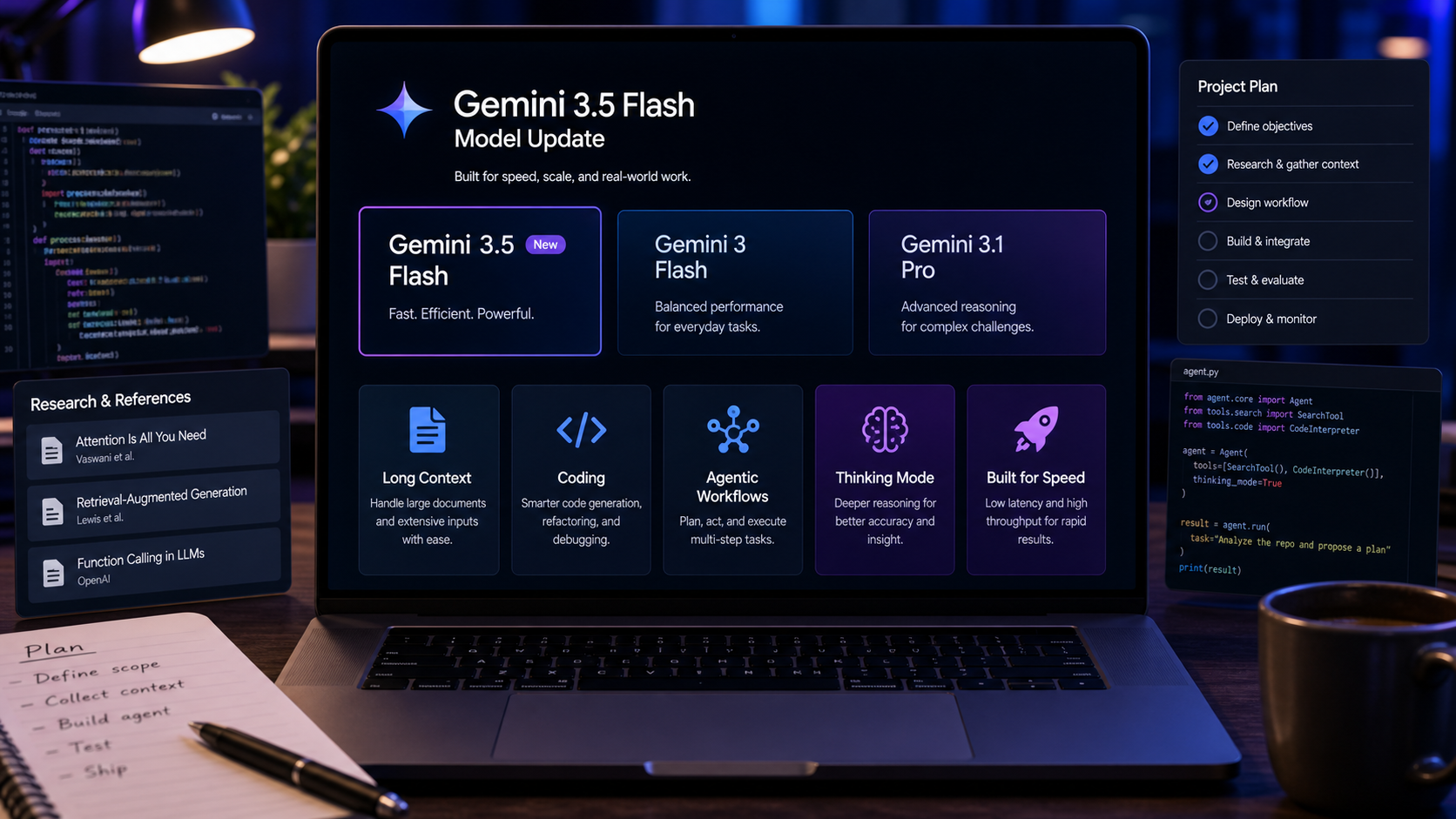
Gemini 3.5 Flash new features matter because Google is positioning the model as a faster, more agentic Flash option for coding, long-context work, research, structured writing, and repeated productivity tasks. As of May 29, 2026, Google lists gemini-3.5-flash as a stable Gemini API model, while Chat4o currently has related Gemini-family pages such as Gemini 3 Flash, Gemini 3.1 Pro, and Gemini 2.5 Flash for comparison and prompt exploration.

What Gemini 3.5 Flash Adds for Fast AI Workflows
Gemini 3.5 Flash is best understood as a fast model built for more serious multi-step work than earlier lightweight Flash use cases. Google's official Gemini API page describes it as optimized for real-world tasks, sub-agent deployment, multi-step workflows, long-horizon work, and complex coding cycles. That makes the upgrade especially relevant for developers, researchers, students, analysts, marketers, and creators who run many AI tasks per day.
The major verified feature changes are practical rather than cosmetic:
- Stronger agentic performance: Google frames Gemini 3.5 Flash around agentic execution, rapid loops, sub-agent deployment, and multi-step workflows.
- Coding support: The model is positioned for iterative coding cycles, debugging, prototyping, and alternate solution exploration.
- Long-horizon task handling: It is designed for tasks that require several turns, tools, documents, or intermediate decisions.
- 1M token context: Google's model page lists a 1,048,576 input token limit.
- 65k max output: The same page lists a 65,536 output token limit.
- Thinking support: Google's Gemini 3.5 Flash docs list thinking as supported and describe thinking levels such as minimal, low, medium, and high.
- Stable model status: Google lists
gemini-3.5-flashas stable, with Gemini 3 Flash Preview noted separately. - Improved speed/intelligence balance: The Flash line remains aimed at fast workflows, while Gemini 3.5 Flash raises the ceiling for more demanding tasks.
One important boundary: the official Gemini API model page says Computer Use is not supported for Gemini 3.5 Flash at this moment. So this article does not treat Computer Use as a Gemini 3.5 Flash feature.

Gemini 3.5 Flash vs Gemini 3 Flash, Gemini 3.1 Pro, and Gemini 2.5 Flash
The practical comparison is not "newer always wins." A better question is which model fits the job. Gemini 3.5 Flash looks most useful when you want Flash-style speed but need stronger reasoning, coding, long context, and agentic task handling than a basic fast model.
Here is the user-level way to think about the lineup:
| Model | Practical fit | Where it makes sense |
|---|---|---|
| Gemini 3.5 Flash | Newer fast model for agentic, coding, long-context, and high-frequency workflows | Try first when speed matters but the task is more complex than a simple summary or rewrite |
| Gemini 3 Flash | Fast Gemini-family option for quick understanding, structured replies, and common productivity tasks | Good for prompt testing, fast Q&A, content organization, and lightweight reasoning |
| Gemini 3.1 Pro | Pro-style option for complex tasks where depth may matter more than latency | Useful for harder reasoning, more careful drafting, and model comparison against Flash behavior |
| Gemini 2.5 Flash | Earlier Flash reference point for lightweight multimodal and fast AI workflows | Useful as a baseline when comparing how much the newer Flash generation improves your workflow |
For creators and marketers, the main question is whether Gemini 3.5 Flash helps produce better briefs, hooks, outlines, campaign variants, and research summaries with less waiting. For students and researchers, the test is whether it handles long documents, structured notes, contradictions, and study plans more reliably. For developers, the key test is whether it can maintain context through debugging, refactoring, and implementation planning.
That is why a Gemini Flash model comparison should use your own prompts, not only marketing claims. Run the same coding, research, and writing tasks through Gemini 3 Flash, Gemini 3.1 Pro, and Gemini 3.5 Flash when available, then judge accuracy, structure, latency, and revision effort.

Best Uses for Creators, Students, Researchers, Developers, and Marketers
Gemini 3.5 Flash is most compelling when the task is frequent, structured, and a little too complex for a quick chatbot answer. That includes daily coding support, long-context document review, research organization, structured writing, planning, and agentic workflows where the model needs to keep track of multiple steps.
Creators can use it to turn messy notes into scripts, outlines, thumbnails briefs, newsletter plans, and content calendars. Marketers can test audience angles, landing page copy, product positioning, campaign variants, and competitive summaries. Students can ask for study plans, concept maps, quiz questions, and document summaries. Researchers can ask for claims, evidence, contradictions, assumptions, and follow-up questions. Developers can ask for code review, debugging plans, architecture outlines, API route maps, database schemas, and test coverage ideas.
The model is also relevant for productivity-focused users who want structured output. If your current AI workflow involves repeatedly asking for tables, JSON, checklists, briefs, or project plans, Gemini 3.5 Flash is worth testing because Google's docs list structured outputs, function calling, code execution, file search, URL context, grounding, and thinking as supported capabilities.
Use it with realistic expectations. It may be faster and more capable than older Flash models for many tasks, but users still need to check facts, code behavior, citations, privacy constraints, and final publishing requirements.

Reusable Gemini 3.5 Flash Test Prompt Formula and Examples
The best way to evaluate Gemini 3.5 Flash is to test it against your actual work. Use one reusable prompt structure, then swap in different task types, documents, code snippets, or planning goals.
Copy this formula:
You are testing Gemini 3.5 Flash for [task type: coding, research, planning, writing, long-context analysis, agentic workflow]. My goal is [goal]. Input/context: [paste material or describe task]. Please produce [output format]. Use step-by-step reasoning internally, but return a clear final answer. Identify assumptions, risks, missing information, and next actions.
Use these copy-to-use prompts to test practical capability:
- I want to test Gemini 3.5 Flash for coding. Review this code, identify bugs, suggest improvements, and provide a clean fixed version with comments: [paste code].
- I want to test Gemini 3.5 Flash for long-context research. Summarize this long document into key claims, evidence, contradictions, and action items. Separate facts from interpretation: [paste document].
- Build a 7-day study plan for [subject]. Include daily goals, review checkpoints, quiz questions, and a final practice test outline.
- Compare these three AI tools for my workflow: [tool A], [tool B], [tool C]. Evaluate speed, cost, reasoning, coding, writing quality, and best use cases.
- Turn these messy notes into a structured article brief with title, angle, target readers, main sections, keywords, and cautions: [paste notes].
- Help me debug this product idea. Identify target users, pain points, competitor risks, MVP features, pricing concerns, and launch steps.
- Analyze this spreadsheet-style data pasted below. Find trends, anomalies, possible explanations, and business recommendations: [paste data].
- Create a coding task plan for building [app/tool]. Break it into architecture, API routes, database structure, UI components, testing, and deployment.
- Rewrite this paragraph in a clearer professional tone without changing the meaning: [paste paragraph].
- Create an agentic workflow for completing [project]. Break it into subtasks, required tools, decision checkpoints, risk checks, and final deliverables.
- Generate a prompt-testing checklist for Gemini 3.5 Flash. Include tests for long context, reasoning, coding, structured output, factual verification, and refusal boundaries.
- Compare Gemini 3.5 Flash with Gemini 3 Flash and Gemini 3.1 Pro for my use case: [describe use case]. Recommend which model to try first and why.
When comparing outputs, do not only ask which answer "sounds smarter." Check whether the model preserves instructions, handles long context, separates facts from interpretation, produces the requested format, admits uncertainty, and gives usable next actions.

How to Use Chat4o for Gemini Model Research and Updates
Chat4o is useful as a Gemini-family research and comparison hub, especially while model names and release details are changing quickly. The cautious approach is to use Chat4o's Gemini 3 Flash, Gemini 3.1 Pro, and Gemini 2.5 Flash pages as related resources until a dedicated Gemini 3.5 Flash page is available.
For broader context, Chat4o also has model comparison and release-style articles such as ChatGPT vs Grok vs Claude vs Gemini in 2026 and Gemini 3.1 Pro Release: What's New and Is It Better Than Gemini 3.0?. These are helpful for understanding how Chat4o frames Gemini-family updates and how users can compare Gemini with other AI assistants.
Recommended Chat4o reading:
- Gemini 3.1 Pro Release: What's New and Is It Better Than Gemini 3.0?
- ChatGPT vs Grok vs Claude vs Gemini in 2026: Which AI Actually Leads Where?
- Gemini 2.5 Flash: The Lightweight AI Powerhouse of 2025
- All About Gemini 3.0 - Google's Upcoming AI Model and What to Expect in 2026
- Discover Grok 4 - Elon Musk's Next-Gen AI Model, Now on Chat4o
- Grok Imagine in 2026: xAI's Latest News, Creator Push, and Where to Try Grok 4
The safest editorial note is simple: use official Google pages for exact Gemini 3.5 Flash specifications, and use Chat4o for related Gemini model pages, comparison reading, and user-facing AI model research.

Cautions: Availability, Pricing, Tools, and Rollout Can Change
Gemini 3.5 Flash is a current model story, so fixed claims can age quickly. Availability, access tiers, pricing, rate limits, supported tools, platform integrations, regional rollout, and UI placement may change after publication. For developers, the safest workflow is to check Google's model docs, pricing page, rate limit page, and release notes before making product or infrastructure decisions.
Use these caution checks before you publish a guide, choose a model, or build on the API:
- Availability: confirm whether Gemini 3.5 Flash is available in the product, API, region, or plan you intend to use.
- Pricing and rate limits: verify current pricing and quota details from official pages.
- Tool support: check exact tool support for your API path. Do not assume Computer Use support; Google's Gemini 3.5 Flash model page lists it as not supported at this moment.
- Thinking settings: Google recommends
thinking_levelrather than older thinking budget patterns for Gemini 3.x models. - Context and output limits: 1M input and 65k output are listed in the model docs, but your app design still needs token counting, truncation, and cost controls.
- Data and privacy: avoid pasting private, regulated, or confidential material unless your chosen platform and account settings allow it.
- Fact checking: long-context summaries and research outputs still need source review.
- Code validation: generated code should be tested, linted, reviewed, and checked for security issues.
For most users, the upgrade matters if it reduces revision work. If the model gives a better first draft, holds context longer, and handles coding or research tasks with fewer corrections, it can be valuable even when the final answer still needs human verification.

FAQ: Gemini 3.5 Flash New Features
Is Gemini 3.5 Flash officially available?
Yes. Google's Gemini API docs list gemini-3.5-flash as a stable model, with a latest update in May 2026. Access details may still depend on product surface, region, plan, API availability, and rollout timing.
What is the biggest Gemini 3.5 Flash upgrade?
The biggest practical upgrade is the combination of Flash-style speed with stronger agentic execution, coding support, long-horizon task handling, thinking support, 1M context, and 65k max output.
How is Gemini 3.5 Flash different from Gemini 3 Flash?
Gemini 3 Flash is a fast Gemini-family model for quick tasks, while Gemini 3.5 Flash is positioned as a newer and more capable Flash option for agentic, coding, and long-context workflows. Users should compare them with the same prompts before switching their daily workflow.
Should I use Gemini 3.5 Flash or Gemini 3.1 Pro?
Try Gemini 3.5 Flash first when speed, repeated usage, coding loops, and long-context productivity matter. Try Gemini 3.1 Pro when your workflow benefits from a Pro-style model comparison or when you want to compare Flash behavior against a deeper model option.
Does Gemini 3.5 Flash support Computer Use?
Google's Gemini 3.5 Flash model page says Computer Use is not supported at this moment. Do not describe Computer Use as a Gemini 3.5 Flash feature unless official docs change.
Can students use Gemini 3.5 Flash for study plans and research?
Yes, it is a good candidate for study planning, summaries, quiz generation, and long-document organization. Students should still verify sources, citations, formulas, and factual claims before relying on the output.

Conclusion: Should You Care About Gemini 3.5 Flash?
Gemini 3.5 Flash new features are worth watching if you need fast AI help for coding, research, long documents, planning, writing, and structured productivity workflows. The headline is not only speed; it is speed paired with more capable agentic and long-horizon behavior.
For practical users, the right next step is testing. Run the same coding review, research summary, writing brief, and planning prompt through Gemini 3.5 Flash, Gemini 3 Flash, and Gemini 3.1 Pro when available. Then compare accuracy, format control, context retention, speed, and how much editing you need afterward.
For official details, read Google's Gemini 3.5 Flash API model docs, What's New in Gemini 3.5 Flash, and Google's Gemini 3.5 announcement. For related model exploration and comparison reading, use Chat4o's Gemini pages and AI model comparison articles as a companion resource.