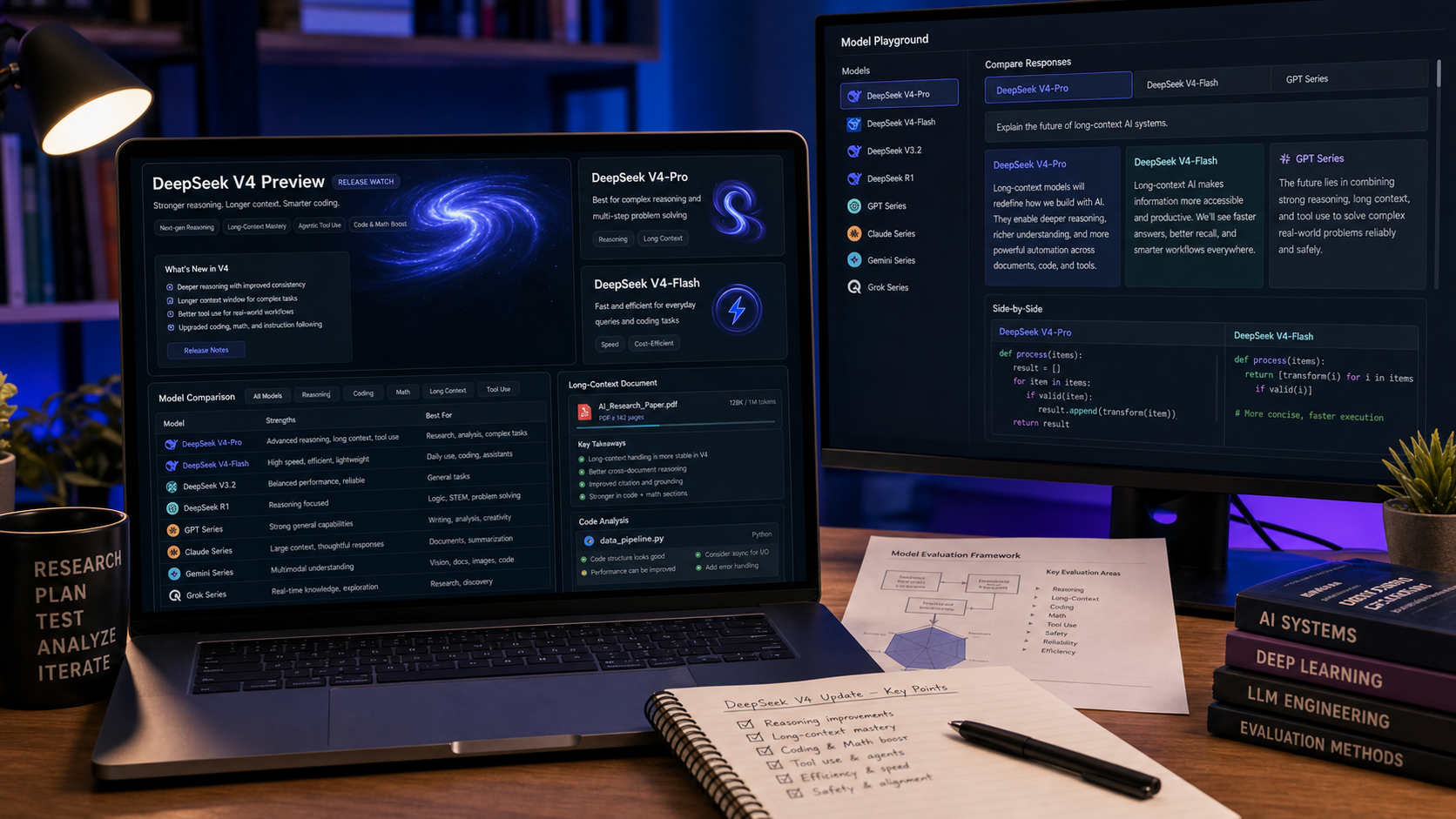
DeepSeek V4 update vs ChatGPT is not a simple “winner takes all” comparison for academic work. The practical question is which tool fits your research workflow: long-context reading, source synthesis, coding, reasoning, academic writing, math checks, or paper revision. For many students and researchers, the best setup is to test DeepSeek V4 and ChatGPT for model-level work, then use AI Scholar GPT as a focused academic companion for rewriting, math solving, source-conscious review, and paper workflow refinement.

Article Task Card
| Item | Details |
|---|---|
| Target reader | Students, researchers, academic writers, developers, and AI tool evaluators |
| Article type | Objective comparison guide |
| Main keyword | DeepSeek V4 update vs ChatGPT |
| Supporting keywords | DeepSeek V4 research workflow, ChatGPT for academic research, AI research assistant, AI Rewrite Text, AI Math Solver |
| Target length | Concise, about 1,300 words |
| Tone | Balanced, practical, source-aware |
| Must include | Research comparison, ScholarGPT recommendation, FAQ, cautions |
| Must avoid | Fake benchmark scores, fake pricing tables, unsupported “best” claims |
| CTA | Use ScholarGPT AI for research support, rewriting, and math checks |
| Output format | Markdown article with images in every H2 section |
What the DeepSeek V4 Update Changes for Academic Research
The DeepSeek V4 update matters for research workflows because it is positioned around long context, reasoning, coding, and open model access. DeepSeek’s official V4 Preview Release says DeepSeek-V4 Preview is live and open-sourced, with DeepSeek-V4-Pro and DeepSeek-V4-Flash as the two main variants.
According to the official DeepSeek V4 Preview Release, V4-Pro is described as the larger model, while V4-Flash is positioned as the faster and more economical option. The same release highlights 1M context length, API availability, and dual Thinking / Non-Thinking modes for both models. Those details are useful for long papers, multi-source note sets, code-heavy research, and large literature review drafts.
For academic users, the key change is not just “more intelligence.” It is the ability to put more material into one research session and ask the model to compare, outline, summarize, or reason across that material. That can help with a DeepSeek V4 research workflow such as reading several abstracts, extracting methods, comparing limitations, or turning rough notes into a research plan.
Still, treat DeepSeek’s benchmark and pricing claims as live facts that must be checked before publication. Model names, API behavior, prices, aliases, availability, and retirement timelines can change, so verify the DeepSeek API Docs and Models & Pricing pages before writing fixed claims into a paper, product page, or procurement note.

DeepSeek V4 vs ChatGPT for Research, Coding, and Source Synthesis
DeepSeek V4 vs ChatGPT depends on the task, not on a universal ranking. DeepSeek V4 is especially interesting when you want long-context model testing, open-weight evaluation, API experimentation, coding assistance, or a comparison between V4-Pro and V4-Flash. ChatGPT is often more convenient when you want a polished assistant experience, multimodal interaction, file-based work, or deep research features available inside ChatGPT.
Here is the practical comparison:
| Research need | DeepSeek V4 may fit when... | ChatGPT may fit when... |
|---|---|---|
| Long-context reading | You want to test DeepSeek’s 1M-context positioning on large notes, papers, or codebases. | You want a more guided assistant interface and file-based workflows where available. |
| Source synthesis | You want to compare how V4-Pro or V4-Flash organizes evidence from pasted source material. | You want ChatGPT deep research-style outputs with source links or citations where the feature is available. |
| Coding | You want API access, agentic coding tests, or open-model evaluation. | You want interactive debugging, explanation, and developer workflow support in a familiar assistant. |
| Academic writing | You want outlines, research questions, methods explanations, and draft restructuring. | You want iterative writing support, tone revision, and source-aware drafting help. |
| Cost and deployment | You need to compare DeepSeek API pricing and open-weight options directly. | You need to check ChatGPT plan access, file limits, tools, and API options on OpenAI’s current pages. |
For ChatGPT, verify current access and capabilities through official OpenAI resources such as Deep Research in ChatGPT, Introducing Deep Research, OpenAI File Uploads FAQ, and the Deep Research API Guide. Do not assume every user has the same file limits, tool access, pricing, model routing, or research features.
The safest recommendation is to run a small research benchmark of your own. Use the same paper abstract, dataset note, code file, or literature review paragraph in both systems. Compare factual accuracy, citation discipline, structure, writing clarity, hallucination risk, and how easy it is to verify the output.

Where ScholarGPT AI Fits Beside DeepSeek V4 and ChatGPT
ScholarGPT AI fits best as a practical academic layer around broader AI models. DeepSeek V4 and ChatGPT can help with general reasoning, long documents, coding, and synthesis, while ScholarGPT AI is useful for focused academic tasks such as rewriting paragraphs, checking math steps, organizing paper workflows, and reviewing source-dependent claims more carefully.
Use AI Rewrite Text when you already have your own paragraph and want clearer academic wording without changing the meaning. This is important because research writing should preserve the author’s argument and avoid adding unsupported claims. A good rewrite workflow is: paste your paragraph, ask for clarity and tone only, then compare the revised version against your original sources.
Use AI Math Solver for equation-heavy study, statistics checks, and technical explanations. It should not replace a textbook, instructor, or methods reviewer, but it can help break down a formula, identify missing assumptions, or explain why a result needs verification.
For full paper workflows, ScholarGPT AI is strongest when paired with human judgment:
- Use DeepSeek V4 or ChatGPT to summarize notes and generate possible research questions.
- Use ScholarGPT AI to polish paragraphs, clarify math, and structure the paper workflow.
- Return to original papers for citation checks and evidence verification.
- Mark every claim as sourced, interpretation, assumption, or needs verification.
This is also why an AI research assistant should be treated as a support tool, not an academic authority. The model can help you read faster, but it cannot guarantee citation accuracy or replace source review.

Final Recommendation, FAQ, and Responsible Research Checklist
Choose DeepSeek V4 if your priority is long-context model testing, API experimentation, open-weight evaluation, coding comparisons, or testing DeepSeek-V4-Pro versus DeepSeek-V4-Flash. Choose ChatGPT if your priority is a polished assistant experience, deep research workflows where available, file-based interaction, and broad productivity support. Add ScholarGPT AI when you need a simpler academic companion for rewriting, math clarification, paper organization, and source-conscious review.
Before using any output in academic work, follow this checklist:
- Verify model names, pricing, API access, context windows, output limits, and availability on official pages.
- Check every citation against the original paper, not only an AI summary.
- Separate confirmed facts from interpretations and assumptions.
- Do not let AI invent references, quotes, methods, datasets, or benchmark claims.
- Follow your school, journal, or publisher’s AI-use disclosure policy.
- Use AI Rewrite Text for clarity, not for adding claims you did not verify.
- Use AI Math Solver as a study and checking aid, not as final authority.
FAQ
Is DeepSeek V4 better than ChatGPT for academic research?
It depends on the workflow. DeepSeek V4 may be better for long-context testing, open-model evaluation, and API experiments, while ChatGPT may be easier for interactive research assistance and deep research features where available.
Can DeepSeek V4 replace source verification?
No. DeepSeek V4, ChatGPT, and any AI research assistant can misread sources, omit caveats, or produce unsupported claims. Always verify original papers and citations.
What is the difference between DeepSeek-V4-Pro and DeepSeek-V4-Flash?
DeepSeek positions V4-Pro as the larger, more capable model and V4-Flash as the faster, more economical option. Check the official DeepSeek pages before relying on current pricing, API behavior, or availability.
How should students use ScholarGPT AI with ChatGPT or DeepSeek V4?
Use the broader models for brainstorming, summarizing, coding, or long-context analysis. Then use ScholarGPT AI for rewriting, math solving, source-checking structure, and paper workflow cleanup.
Related Articles
- DeepSeek 4.0 Deep Research Review: Using DeepSeek V4 for Research Workflows
- ChatGPT 5.4 for Academic Research: A Practical, Unhyped Review
- How to Use Scholar GPT for Your Paper
- AI-Powered Research Assistants Explained
- Gemini 3.5 Flash for Research Review
- Rewrite Text AI with Scholar GPT AI
- How to Solve Math Problems Faster with ScholarGPT’s Math Solver AI
People Also Read
- DeepSeek V4 Update Explained on Chat4O AI
- OpenAI GPT-5.5 Review
- Grok 4 vs Chat GPT 5
- Reuters: DeepSeek-V4 Adapted for Huawei Chips
- The Verge: DeepSeek Previews New AI Model
- Tom’s Hardware: DeepSeek Launches V4 on Huawei Chips
Conclusion
The practical answer to DeepSeek V4 update vs ChatGPT is conditional. Test DeepSeek V4 when long context, open access, API work, or Pro-versus-Flash evaluation matters; test ChatGPT when you need a polished assistant and deep research workflows where available. For academic writing, math checks, and source-aware paper refinement, keep ScholarGPT AI in the workflow and verify every important claim yourself.