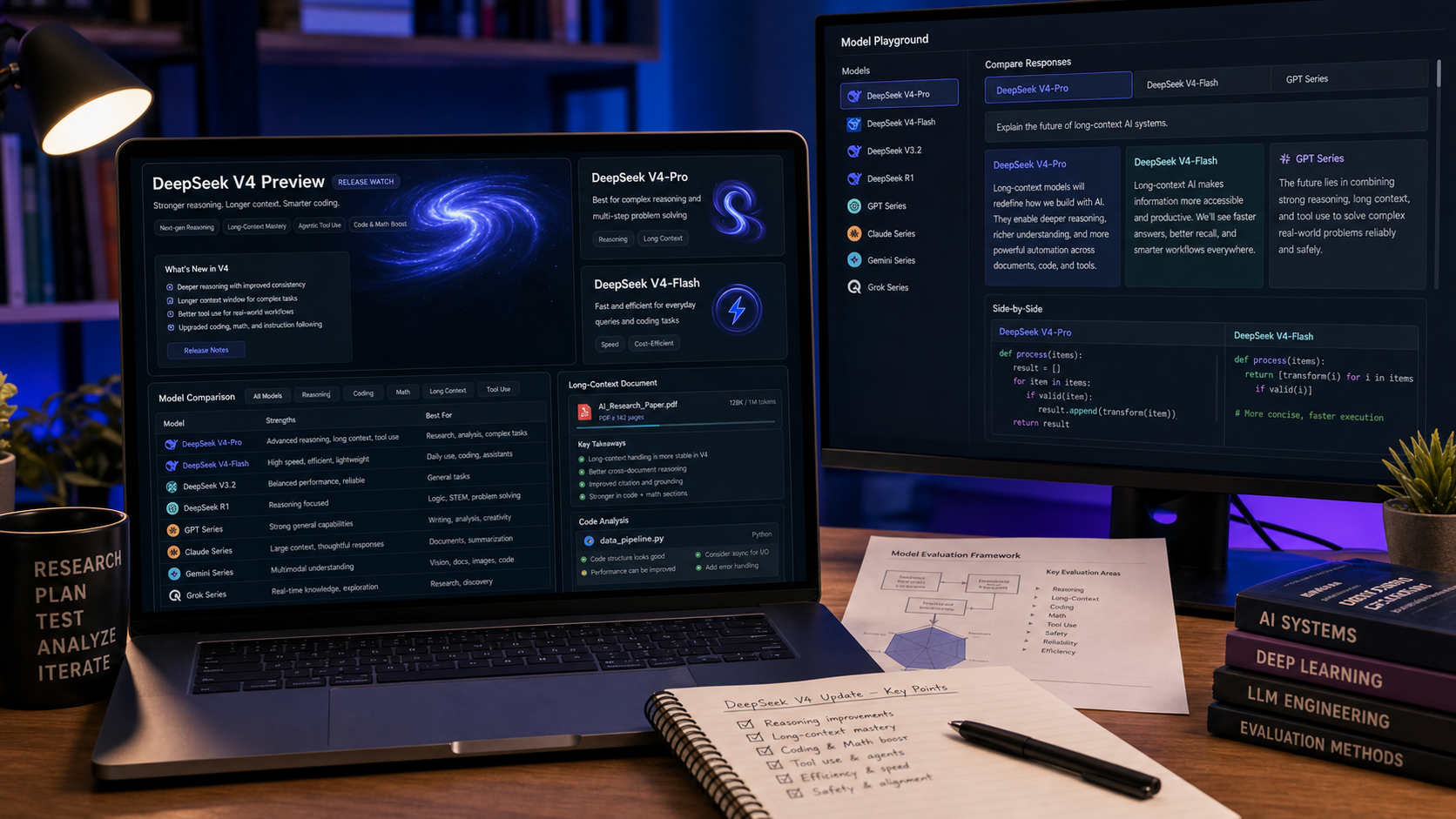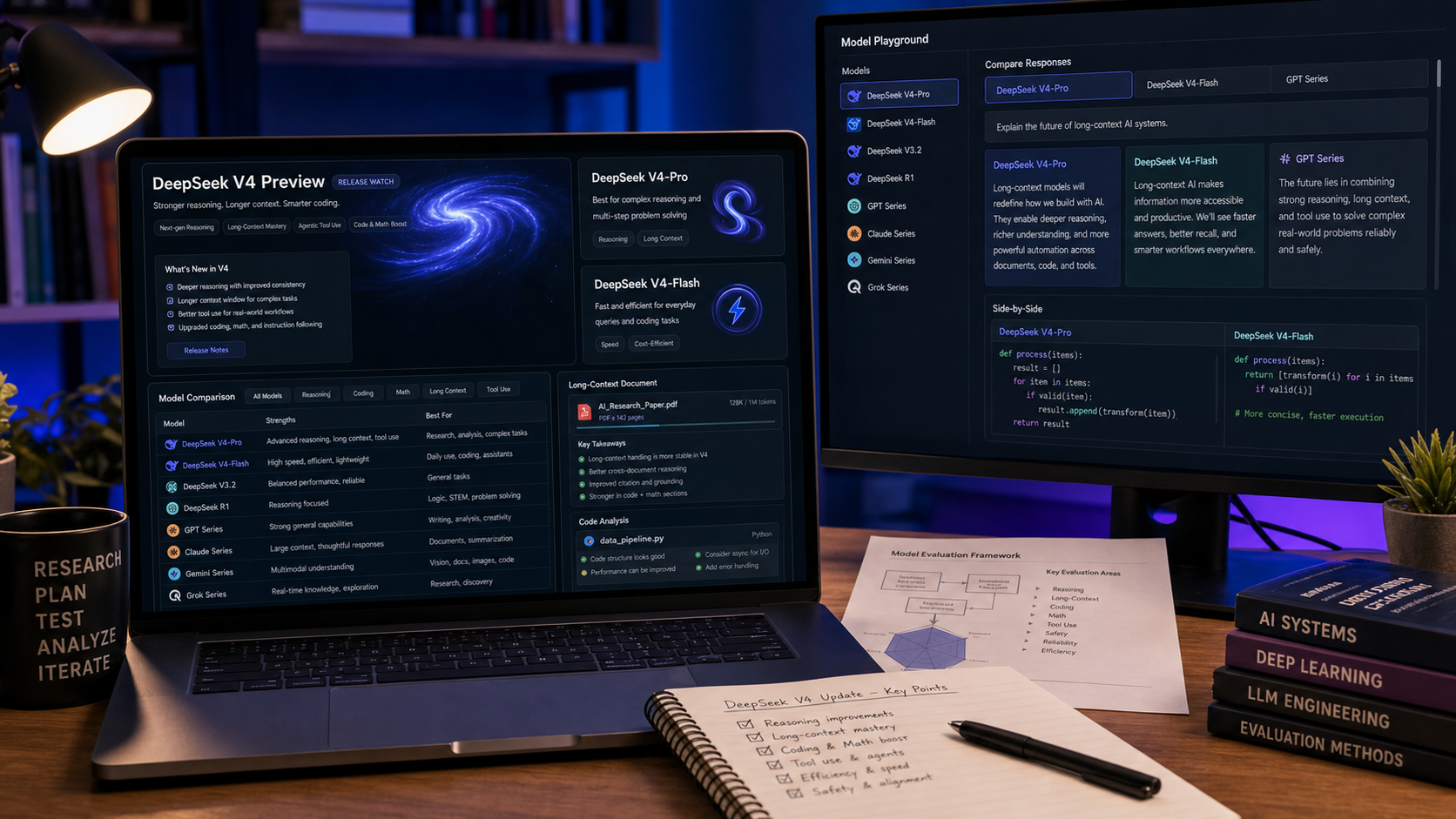
The DeepSeek V4 Update is worth watching because DeepSeek’s official V4 Preview positions the next model family around long-context work, reasoning, coding, agent workflows, and a two-model strategy: V4-Pro for higher capability and V4-Flash for faster, more economical use. For readers comparing DeepSeek AI with GPT, Claude, Gemini, Grok, and other frontier models, the practical question is not only “Is DeepSeek V4 real?” but also “Where can I test similar workflows today?”
Chat4O AI is a useful practical starting point because it already provides DeepSeek-related pages for DeepSeek V3.2, DeepSeek R1, and DeepSeek V3, along with broader model comparison content across GPT, Claude, Gemini, Grok, and other AI systems. The important caution: do not assume direct DeepSeek V4 access on Chat4O unless a live Chat4O V4 model page is verified before publishing.

What the DeepSeek V4 Update Represents
DeepSeek V4 Preview appears to be a major model-family update after earlier V3, V3.2, and R1 workflows. The official release framing matters because it points to a broader DeepSeek roadmap: longer context, stronger agentic behavior, coding support, reasoning, and cost-efficient deployment.
The clearest public distinction is the V4 family structure. V4-Pro is positioned for heavier tasks, while V4-Flash is positioned for faster and more economical workflows. That mirrors a broader industry pattern: one model for deeper work and another for high-frequency everyday tasks.
The update also matters because DeepSeek continues to be part of the open-source and open-weight model conversation. Users should still verify current model IDs, API availability, pricing, context limits, output limits, license terms, hosted access, and region availability against the official DeepSeek API Change Log before making product or procurement decisions.

What Changed From DeepSeek V3, V3.2, and R1
The safest way to understand DeepSeek V4 is to treat it as a family update, not as a simple replacement for every earlier DeepSeek workflow. DeepSeek V3 and V3.2 are useful to discuss as general-purpose and coding-friendly DeepSeek-style models, while R1 is strongly associated with reasoning-heavy workflows.
The V4 Preview conversation shifts attention toward longer context and more agent-like work. That matters for users who want to analyze long documents, work through code repositories, compare research notes, plan multi-step tasks, or build assistants that need to keep more context active. It does not mean every earlier model becomes obsolete; it means users should compare tasks instead of choosing by name alone.
On Chat4O, DeepSeek V3.2 explained is still a useful current resource because it helps readers understand the practical differences between V3.2, V3, and R1 before assuming V4 is available in every third-party interface.

DeepSeek V4-Pro vs V4-Flash: Which One Fits Which Task?
DeepSeek V4-Pro and DeepSeek V4-Flash should be understood as different workflow choices. V4-Pro is the higher-capability option to consider for complex reasoning, coding, agentic workflows, long analysis, and technical tasks where accuracy and depth matter more than latency.
V4-Flash is the faster and more economical option to consider for everyday chat, summarization, lightweight coding, drafting, support assistants, and scaled application use. It may be the more practical choice when a product team needs many responses quickly or when the task does not justify a heavier model.
Neither option is automatically “best.” The right choice depends on task complexity, latency requirements, cost sensitivity, model availability, hosted access, context needs, and whether the model is being used for personal testing, internal tools, or production systems.

Why 1M Context Matters for Research, Code, and Agents
Long context matters because many real workflows do not fit neatly into a short chat. A model positioned around 1M context can be relevant for long PDFs, codebases, legal drafts, documentation sets, research notes, conversation history, and multi-step agent plans.
For students and researchers, long context can help with literature notes, source comparison, and structured summaries, though original sources still need verification. For developers, it can support codebase review, debugging plans, architecture notes, and migration outlines. For analysts and startup teams, it can help organize business documents, customer research, strategy drafts, and decision memos.
Long context does not remove hallucination risk. It gives the model more material to work with, but users still need source checking, citation review, privacy safeguards, and human judgment before treating an answer as final.

How to Use Chat4O AI for Current DeepSeek-Style Testing
Chat4O AI is best positioned as a practical model-testing environment while DeepSeek V4 availability is verified. Instead of waiting for every new model page, users can test current DeepSeek-style reasoning, coding, writing, and assistant workflows through the available DeepSeek pages on Chat4O.
Use DeepSeek V3.2 on Chat4O for current DeepSeek-style language, coding, and reasoning tasks. Use DeepSeek R1 on Chat4O when the task is more reasoning-heavy, such as math, logic, structured analysis, or multi-step decisions. Use DeepSeek V3 on Chat4O for broader DeepSeek model context and general-purpose comparison.
Until a verified DeepSeek V4 page is live, the careful recommendation is this: use Chat4O to test available DeepSeek workflows, compare them against GPT, Claude, Gemini, and Grok-style workflows, and monitor Chat4O’s model pages or articles for future DeepSeek V4 access.

DeepSeek vs ChatGPT, Claude, Gemini, and Grok
The practical DeepSeek vs ChatGPT comparison should be use-case based. Users should compare coding quality, reasoning style, long-context handling, writing tone, multimodal needs, cost sensitivity, safety behavior, ecosystem maturity, API stability, and privacy requirements.
DeepSeek may be attractive for users who care about open model progress, coding, reasoning, and efficient deployment. GPT, Claude, Gemini, and Grok may be better fits depending on tool integrations, writing style, multimodal features, enterprise controls, search or ecosystem access, and model availability in a specific region.
The best test is simple: run the same prompt across several models. Ask each model to review code, summarize a long document, create a study plan, analyze a dataset, write a technical explanation, or break down an agent workflow. Compare not only the answer quality, but also speed, formatting, refusal behavior, hallucination risk, and how easy the output is to verify.

Cautions Before You Assume DeepSeek V4 Access
DeepSeek V4 Preview is official, but preview-stage model news is not the same thing as universal third-party access. Before publishing an access claim or switching a production workflow, verify the current official docs, model IDs, API availability, pricing, context window, output limits, open-source license, hosted access, Chat4O model list, usage limits, privacy terms, and region availability.
Also be careful with benchmark language. Avoid saying DeepSeek V4 is the best open-source model, the best coding model, or the best model for every user unless a current and reliable source supports that exact claim. Preview performance may change, and third-party hosting can differ from official API behavior.
For professional use, test with realistic prompts and human review. AI outputs can hallucinate, misread long context, produce unsupported claims, expose privacy risks if data handling is weak, or fail in edge cases. Treat model updates as opportunities to test, not as automatic reasons to migrate.
FAQ
Is DeepSeek V4 real?
Yes. DeepSeek V4 Preview is listed in the official DeepSeek API news, but users should verify the latest docs and model availability before relying on it.
Does Chat4O AI currently offer DeepSeek V4?
Do not assume that. Chat4O currently has DeepSeek-related pages such as V3.2, R1, and V3, but direct DeepSeek V4 access should be verified on a live Chat4O model page before publishing.
What is the difference between V4-Pro and V4-Flash?
V4-Pro is positioned for higher-capability work such as complex reasoning, coding, and agentic tasks, while V4-Flash is positioned for faster and more economical everyday use.
Should developers switch from DeepSeek V3.2 or R1 immediately?
Not automatically. Developers should test current workloads, compare output quality, latency, cost, availability, privacy terms, and API behavior before switching.
Conclusion: The DeepSeek V4 Update matters because it signals a stronger DeepSeek push into long-context, reasoning, coding, and agent workflows with V4-Pro and V4-Flash. Chat4O AI is a practical place to test available DeepSeek AI workflows today and compare them with GPT, Claude, Gemini, and Grok, while direct DeepSeek V4 access on Chat4O should be verified before any final claim.
Related Chat4O articles include DeepSeek V3.2 Explained, ChatGPT vs Grok vs Claude vs Gemini in 2026, OpenAI GPT-5.5 Review, Claude Opus 4.8 Release, GPT-5.2 vs Claude Opus 4.5, and Free Clawdbot + Claude 4.5.
People also read the DeepSeek V4 Preview Release, DeepSeek API Change Log, DeepSeek Official Website, DeepSeek V3.2 on Chat4O, DeepSeek R1 on Chat4O, and DeepSeek V3 on Chat4O.